
You take a Mister Freeze out of the freezer, distribute three or four to the kids, and the question always arises: are these popsicles really light, or are we just telling ourselves stories because they are water-based? The answer has less to do with the number of calories per tube than with what happens once the sugar is in the body.
Actual composition of a Mister Freeze popsicle: what the label says
A standard 20 ml popsicle contains about 8 kcal, with 2 g of carbohydrates, zero fat, and zero protein. On paper, that’s negligible. To put it into perspective, a scoop of ice cream exceeds 100 kcal by a wide margin.
The problem is that no one eats just one 20 ml popsicle. In practice, the sizes vary. XL tubes or multipack bags contain more generous portions, and the amount of sugar rises proportionally. The main ingredients remain the same: water, glucose-fructose syrup, flavorings, acidifiers, and colorings.
This detailed information can also be found when looking at the calories in a Mister Freeze ice from a global nutritional perspective, and not just by isolated tube.
Nutri-Score and free sugars: why such a light product doesn’t get an A rating
The classic versions of flavored water ice like Mister Freeze generally receive a Nutri-Score B or C. For such a low-calorie product, this is surprising.
The explanation lies in the calculation method of the Nutri-Score revised since 2023-2024: the content of free sugars weighs more heavily in the final score. A popsicle does contain few total calories, but when considering the dry matter, the proportion of simple sugars is very high. There is no fiber, no protein, and no micronutrient to compensate.
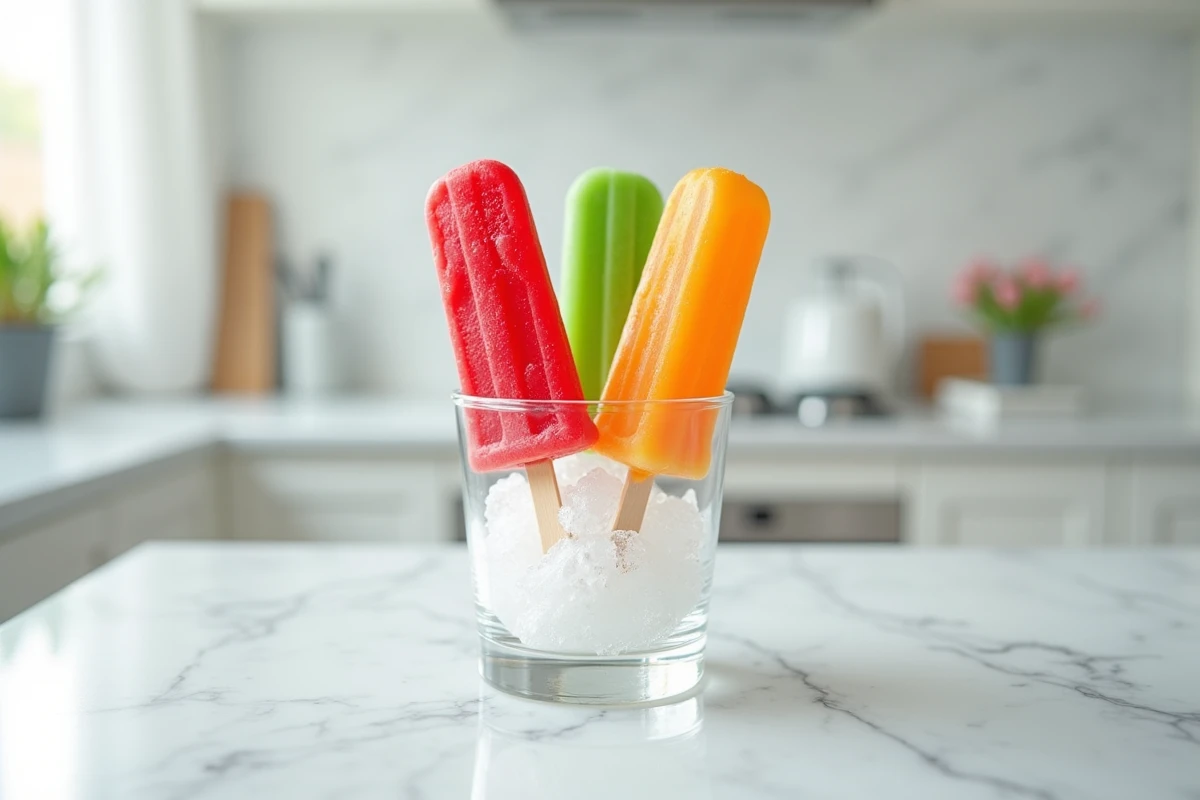
In practical terms, the Nutri-Score reflects a “hollow” nutritional profile: sweetened, flavored, and colored water, with no notable nutritional contribution. This is not a disaster for an occasional treat, but it challenges the common belief that “it’s just water.”
Versions without added sugars: a false good deal for parents
Several recent references offer Mister Freeze without added sugars. The calories drop even further, sometimes to nearly zero levels. Strictly from a caloric standpoint, this is unbeatable.
However, these versions rely on sweeteners like acesulfame K or sucralose. Product sheets on Open Food Facts and Yuka evaluations updated in 2024-2025 regularly highlight these additives. For children, the question is different than for an adult controlling calories.
- Intense sweeteners maintain the craving for sweet taste without providing calories, which can sustain a habit of sweet snacking among younger children.
- The additive profile becomes heavier: sugar is swapped for synthetic substances whose long-term effects on the gut microbiome are still debated.
- The Nutri-Score may improve (moving to A or B), but the ingredient list lengthens instead of simplifying.
Feedback on this point varies among families: some prefer a bit of real sugar rather than a combination of sweeteners, while others prioritize strict calorie counting.
Colorings and flavorings: the discreet reformulation of popsicles
The electric blue or bright red of Mister Freeze no longer always comes from the same sources as it did ten years ago. Under European regulatory pressure, popsicle manufacturers have gradually replaced some azo dyes with plant-based colorants: black carrot, spirulina, radish extract.
This reformulation has no impact on calories. However, it does change the qualitative composition of the product. If you read the ingredient lists of recent versions, you’ll notice that controversial artificial colorants (like E110, E122) disappear in favor of mentions like “spirulina concentrate” or “black carrot juice.”
For those who scrutinize labels beyond simple calorie counting, this is a significant change. For those who only look at energy, it makes no difference.
Mister Freeze in a diet: the real calculation to make
Having a 20 ml popsicle after lunch objectively poses no caloric problem. The trap lies elsewhere: the consumption in series during hot weather.
When you eat three or four in a row (which is common, especially among children), you absorb the equivalent in sugar of a small glass of soda. Not catastrophic, but no longer negligible. Sugar consumed in liquid or semi-liquid frozen form quickly enters the bloodstream, with a glycemic spike that the low amount of fiber in the product (zero) does not slow down.
- An isolated popsicle represents a marginal caloric intake and a limited glycemic spike.
- Three to four consecutive popsicles approach 30 to 40 kcal and especially accumulate quick sugars.
- Compared to a whole frozen homemade fruit, the Mister Freeze provides neither fiber, nor vitamins, nor minerals.

The question is not whether a Mister Freeze makes you gain weight (one tube will never change the game), but to measure the cumulative effect on a summer day when several are consumed without thinking.
The popsicle remains one of the least caloric summer treats in the frozen aisle. Its Achilles’ heel is its empty nutritional profile: calories that provide nothing but sugar. Keeping this in mind allows you to enjoy it for what it is, without attributing virtues it does not have.