
Some sandals, despite their popularity, struggle to meet all expectations in terms of comfort, price, or style. Iconic models do not exclusively dominate the market, as several brands compete with innovation to attract a clientele seeking reliable alternatives.
Less exposed manufacturers, but equally demanding in terms of quality, offer different designs and materials, challenging the supremacy of established references. The diversity of the offering encourages a close examination of the available options to make an informed choice.
Why look for an alternative to Birkenstock?
The German brand has established itself over time as the essential reference for comfortable sandals. Birkenstock has built its reputation with models like the Arizona, Boston, Zurich, or Kyoto, appreciated for their cork sole, durability, and ergonomic design. However, this leading position sometimes raises reservations. The homogeneous style, skyrocketing prices, and the excitement around limited edition series from prestigious collaborations (Givenchy, Céline, Manolo Blahnik) lead some to seek something else.
Comfort remains the key issue. But every foot has its requirements, and every step has its particularities. What suits one may not necessarily suit another. Natural leather, birko flor, suede, EVA… the favorite materials of Birkenstock do not have unanimous support. There are also consumers looking for more responsible solutions, originality, or a design that is less recognizable at first glance.
Now, the market is overflowing with varied options to meet these expectations. Choosing among alternatives to Birkenstock for men and women requires targeting specific criteria: support, durability, style, origin. The sandal is no longer just synonymous with relaxation or walking: it is showcased in the city, at work, in hybrid environments where appearance matters as much as comfort.
While Birkenstock continues to take center stage, the vibrancy of the sector should not be underestimated. Exploring other models questions the place of the sandal in current fashion, but also opens the door to new uses, other materials, and unexpected shapes. Alternatives to Birkenstock for men and women broaden the debate, allowing everyone to tailor their choice to their needs, lifestyle, or beliefs.
An overview of brands that overshadow Birkenstock
The market for men’s and women’s sandals has changed significantly: the cork sole signed by Birkenstock no longer holds the monopoly. Brands today compete with ingenuity, quality, and creativity in the field of comfortable footwear.
Many players rely on European leathers crafted artisanally to offer understated, robust, and elegant models. The fit to the shape of the foot, the quality of support, the flexibility of the sole: these details make the difference, whether for a long walk, daily urban use, or relaxed days. Other manufacturers choose to emphasize local production, limiting intermediaries and advocating for responsible manufacturing.
Here are the main families of models offered by these competing brands:
- Sandals with thick soles and multi-position straps to ensure secure support, regardless of the activity.
- Cross-strap mules that combine comfort and discreet elegance, perfect for those who appreciate refined simplicity.
- Open shoes with a distinctive design, aimed at those who want to stand out.
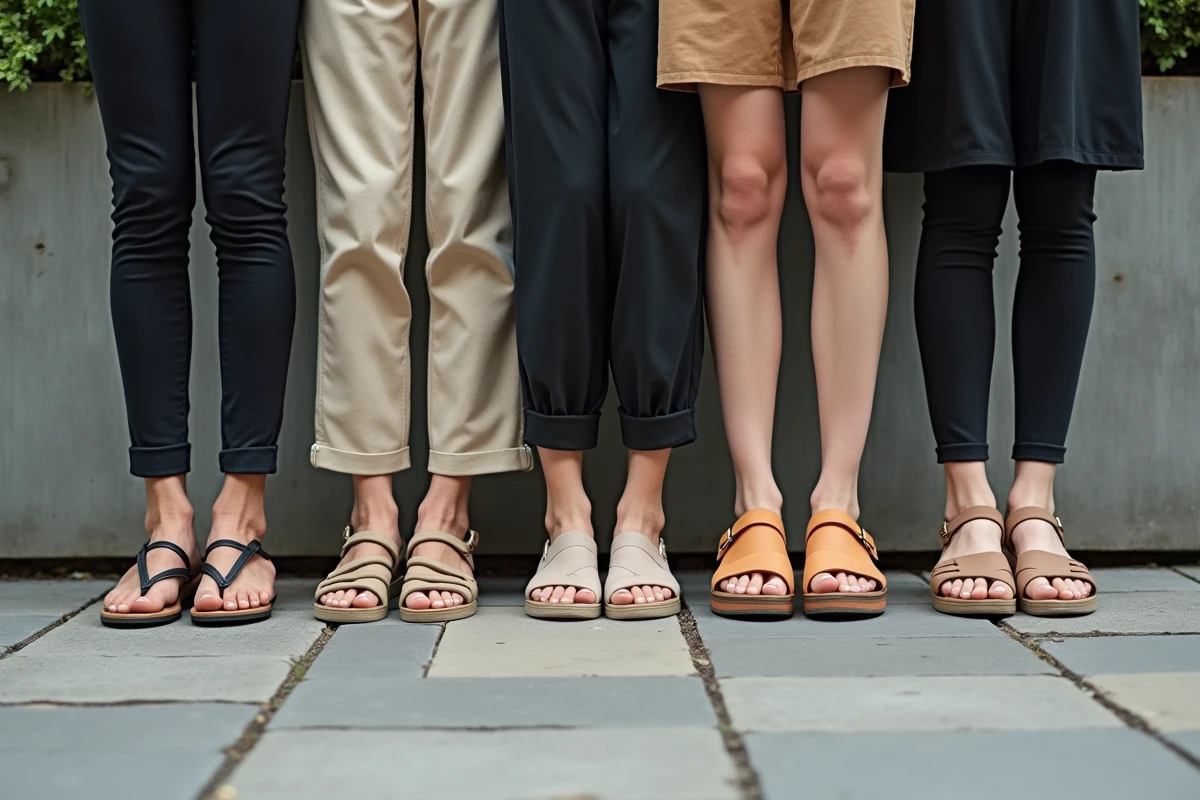
The choice is made according to the use: walking, city, vacation, or work, each situation calls for an appropriate model. Today, textures, colors, and finishes are multiplying, offering consumers a range that is as broad as it is demanding. The sandal asserts itself as a field of expression for designers, artisans, and manufacturers, each reinterpreting this classic of summer fashion in their own way.
How to choose the ideal sandal according to your needs and style
Finding the perfect sandal is not just about slipping on a pair hastily in a store. It’s about finding the balance: comfort, durability, aesthetics. The sandal is not just a matter of weather or trend: it impacts foot health, posture, and the way of walking.
Before choosing, you should ask yourself: how will you wear them? For city dwellers, prioritize understated models, often in leather, with a sufficiently thick sole to absorb unevenness. If walking is your priority, look for sandals with enhanced support, adjustable straps, and anatomical soles that support the foot over time.
Here’s how to navigate according to uses:
- City: clean lines, quality materials, discreet shades.
- Walking: prioritize ergonomics, reinforced arch support, non-slip sole is a must.
- Beach/fisherman: water-resistant materials, quick drying, easy maintenance.
- Artisanal or design: sharp finishes, character, limited series production to stand out.
Don’t stop at appearance: durability and innovation have become determining criteria. Leading brands dare to use new materials without renouncing their heritage. Mediterranean inspirations, urban influences: the sandal is renewing itself, adapting to all profiles, whether it’s about protecting sensitive feet, showcasing a unique look, or fully embracing one’s fashion choices. The sandal is no longer just practical: it asserts, it distinguishes, it accompanies.