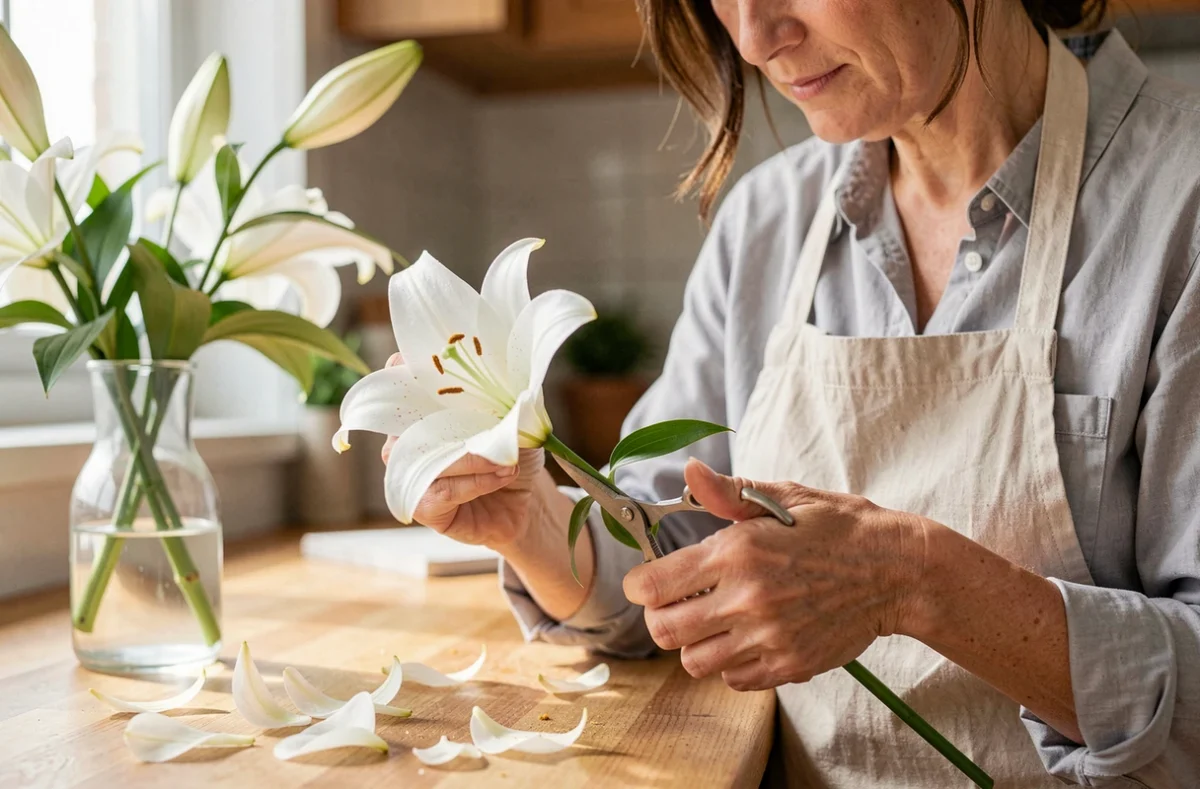
You receive a bouquet of lilies, place it on the table, and two hours later an orange stain marks the tablecloth. The classic reflex is to remove “the pistil,” but the part that stains is not what you think. Before touching anything, it’s better to know exactly where the pollen is and how to intervene without damaging the flower.
Anthers or pistil: the confusion that changes the whole action
Most guides talk about “cutting the pistil of the lilies” to avoid stains. In reality, the pollen comes from the anthers, not the pistil. The pistil is the central part of the flower, the one that bears the sticky stigma at the top. The anthers, on the other hand, are the small elongated sacs attached to the ends of the stamens, on either side of the pistil.
Removing the pistil prevents fertilization but does not eliminate the source of the pollen. To protect tablecloths, clothing, and petals, it is the anthers that should be targeted primarily. You can perfectly leave the pistil in place if the anthers have been properly removed.
When looking for how to cut the pistil of lilies, you often come across tutorials that mix up the two organs. Keeping this distinction in mind allows you to act on the right target and avoid mutilating the flower for no reason.
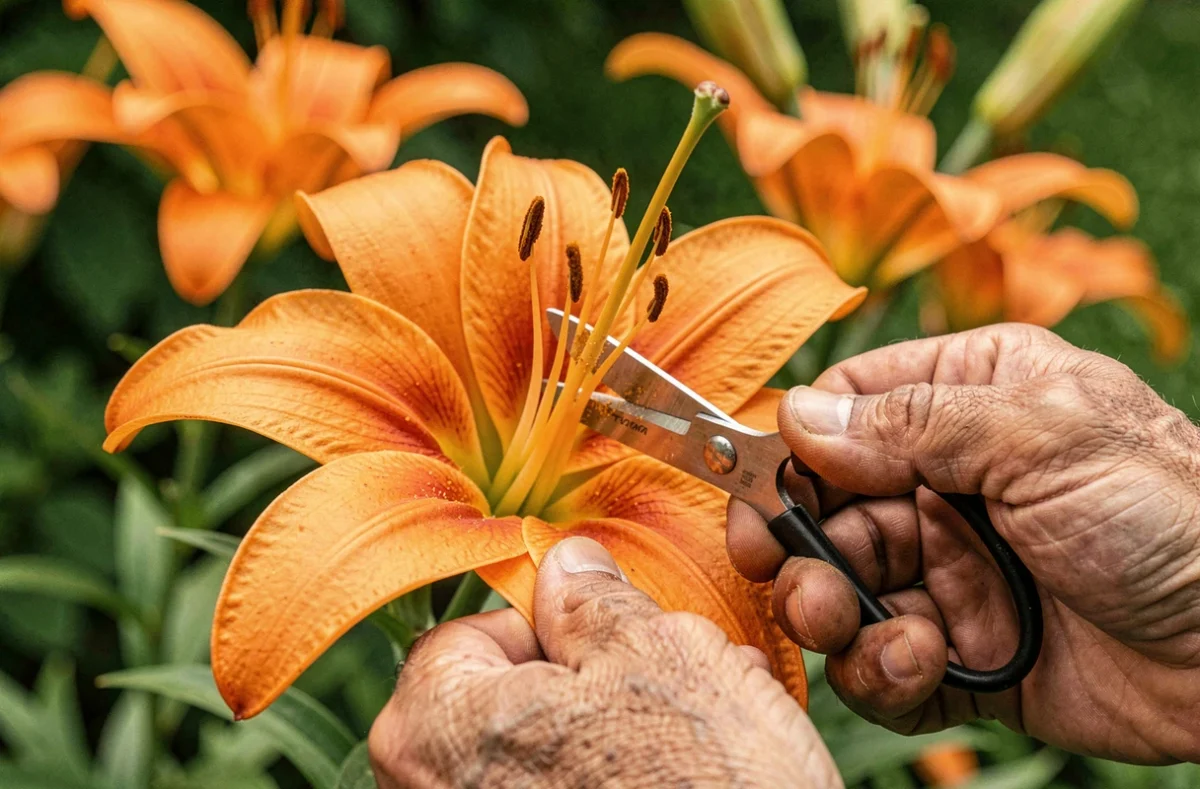
Removing the anthers from lilies before the pollen fully opens
Timing makes all the difference. Intervening before the anthers fully open limits the dispersion of pollen on the petals and around the vase. When the bud has just opened, the anthers are still closed or barely dehiscent: the pollen remains compact and does not fly away at the slightest draft.
Once the anthers are open, the orange powder sticks to fingers, petals, and fabrics. Rubbing to clean makes the damage worse, especially on light cotton or linen. It’s better to intervene early than to try to fix it later.
Materials and concrete method
No need for sophisticated tools. Here’s what works:
- A clean pair of tweezers or a small kitchen tongs. Grasp the anther at its base, where it joins the filament, and gently pull upward without jerking.
- Some absorbent paper under the flower to catch any pollen grains that fall during handling.
- Thin gloves if you want to avoid marks on your fingers, as lily pollen pigment is stubborn on the skin.
Do not cut the filament (the thin stem that holds the anther) unless necessary. Removing only the anther preserves the natural appearance of the flower. If the filament is aesthetically bothersome, it can be trimmed with fine scissors, but this is not mandatory.
Common mistakes that damage lily petals
Pulling sharply on the entire stamen is the most damaging action. The filament is attached to the floral receptacle, and a brutal tug can tear the base of the adjacent petal. Always work by pinching the anther, never by pulling the whole thing out.
Another trap: using scissors that are too wide inside the corolla. Lilies have fleshy but fragile petals at the tips. A sharp scissor or fine tweezers avoids rubbing against the petals during the operation.
Should you touch the stigma of the pistil?
No. The stigma, that sticky surface at the top of the pistil, has no reason to be removed for a vase bouquet. It does not produce pollen and does not stain.
Some clumsy actions aim to cut everything that protrudes from the center of the flower, including the pistil. The result is an empty flower heart, which loses its visual structure. In the vast majority of cases, an intact pistil poses no practical problem.

Lilies and toxicity for cats: removing the anthers is not enough
This point deserves a separate section because it concerns the safety of an animal, not just the aesthetics of a bouquet. True lilies (genus Lilium) are toxic to cats. All parts of the plant are dangerous, not just the pollen.
Carefully removing the anthers reduces the amount of pollen dispersed in the room, but does not make the flower safe. The leaves, petals, stem, and even the water in the vase contain harmful compounds. A cat that chews on a petal or drinks the stagnant water from the vase is at real risk.
The only reliable measure in a home with a cat is to not bring lilies into the house, or to place them in a completely inaccessible room. This is not an excess of caution: veterinary recommendations are clear on this subject.
Caring for the lily bouquet after removing the anthers
Once the anthers are removed, the bouquet does not require any special attention related to this operation. A few simple actions prolong the life of the flowers:
- Recut the stems at an angle every two or three days to maintain good water absorption.
- Change the water in the vase regularly, ideally every day, rinsing the bottom of the vase to eliminate bacterial residues.
- Place the bouquet away from direct heat sources and fruits, which emit ethylene and accelerate wilting.
- Remove leaves that are submerged in water to limit bacterial proliferation.
Removing the anthers has no demonstrated effect on the lifespan of the flower. The action primarily aims to protect textiles and surrounding surfaces. The longevity of the bouquet mainly depends on the freshness of the water and the quality of the stem cuts.
Lilies continue to gradually open in the vase. Each new bud that blooms reveals new anthers loaded with pollen. So, you take the tweezers again with each opening, keeping the same reflex: intervene early, pinch the anther, leave the rest intact.